Shrimp Fish
Aeoliscus strigatus
| Stock | Variations | Price | Quantity |
|---|
Every order ships with our standard 3-hour live arrival guarantee. Need more time? Add our 5-Day Guarantee at checkout.
Full guarantee terms →Ships Monday – Thursday for next-day arrival at your nearest FedEx Hold location — typically ready by 9 AM. We monitor every delivery.
Shipping details →
Monday – Friday 8 AM – 9 PM
Saturday 12 PM – 4 PM
Sunday 12 PM – 9 PM
Healthy, stable animals from vetted suppliers — inspected before packing, shipped overnight. Decades of experience built this model so we can deliver premium livestock at 30%+ less than you'd pay elsewhere.
| Care Level | Expert |
|---|---|
| Temperament | Peaceful |
| Reef Safe | Yes |
| Functional Benefit | Ornamental Only |
| Diet Type | Carnivore |
| Mininum Tank Size | 55 gallons |
| Max Size | 6 inches |
| Temperature | 72–78°F |
| pH Range | 8.1–8.4 |
| Specific Gravity | 1.022–1.025 |
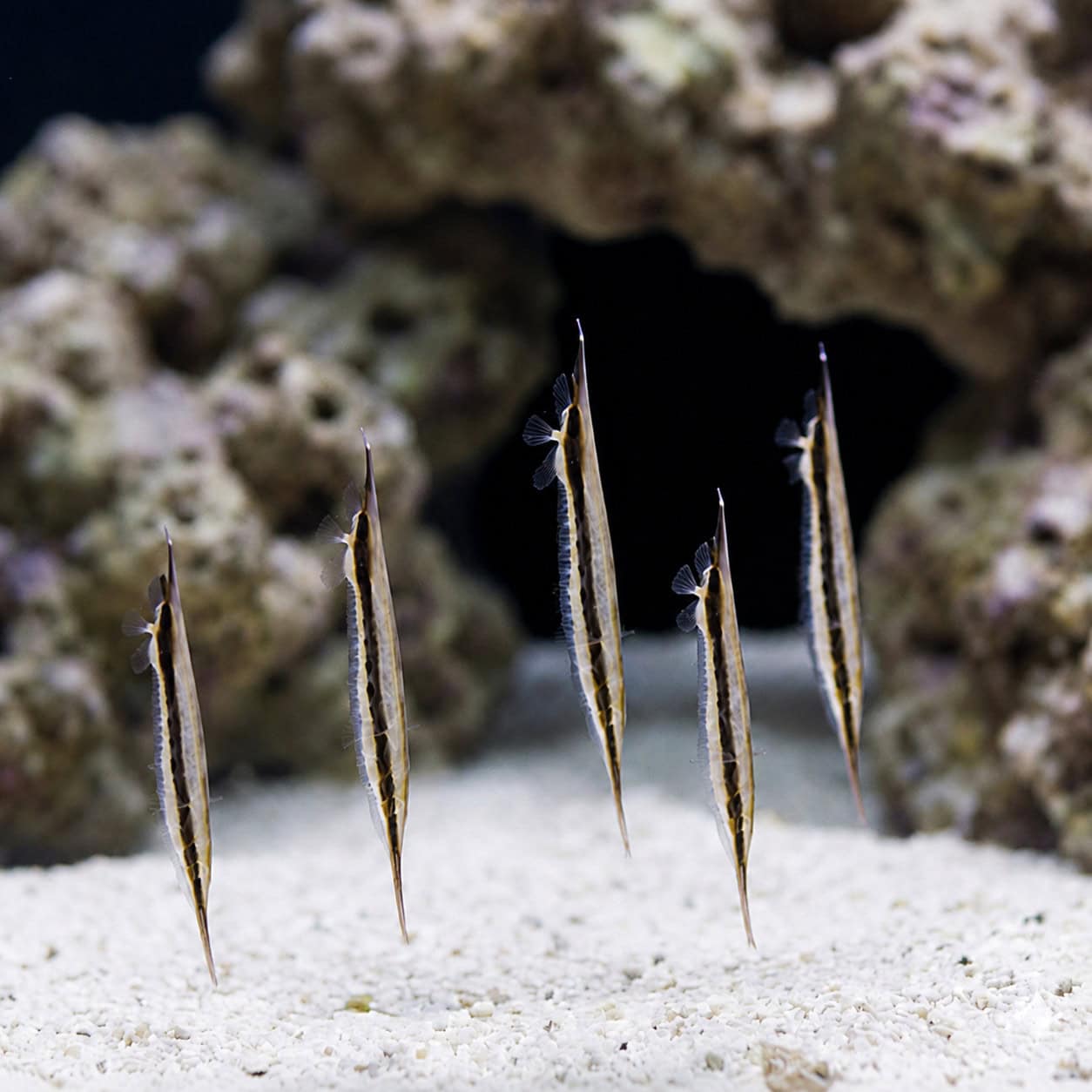
The Striped Shrimpfish (Aeoliscus strigatus), also called the jointed razorfish or coral shrimpfish, is a slender silver fish with a dark side stripe that often swims head-down in the water column. In nature it gathers in groups around branching corals, seagrass, and long-spined urchins, which is why it stands out in a reef aquarium.
What You’ll Observe:
- A tight, synchronized group that turns and “rotates” together while hovering
- Head-down hovering in open water, then drifting back toward cover
- Quick, precise strikes at tiny foods along rock and glass surfaces
- Time spent in the upper water column, especially during daylight hours
- Steady positioning in gentle flow, with short cruises into stronger flow
Provide a mature reef with plenty of live rock and open vertical swimming room, plus caves and overhangs to weave through. Offer small meaty foods several times daily—live or frozen enriched brine shrimp, copepods, and fine frozen plankton foods—so it can feed at its natural pace. It does best with calm, non-competitive tankmates that feed in a similar, unhurried way.
Do shrimpfish always swim head-down, and is it normal if they change orientation?
Head-down hovering is typical, and many will briefly swim more “normally” when repositioning or chasing food. Both behaviors are commonly reported and are part of their natural movement style.
Why do they hover near long spines, branching corals, or gorgonians?
Keepers often notice them choosing structures that resemble urchin spines or branching coral. In the aquarium, branching rockwork and similar “thicket-like” areas tend to bring out that natural hovering-and-cover routine.
How many should I keep to see the schooling behavior people talk about?
Hobbyists most often describe the classic “one unit” schooling look when they’re kept as a small group introduced together. A single fish can work as well, but it usually won’t show the same synchronized movement.
What’s the easiest first food to get them feeding consistently?
Many aquarists start with very small live foods (like baby brine) to trigger strong feeding responses, then blend in frozen micro-foods (often cyclops/other fine plankton) over time. Keeping the food suspended in the water column helps them track and pick it off.
Do they need a deep tank, or can they do well in standard reef dimensions?
Some keepers prefer taller tanks because of their head-down hovering style, but standard reef tanks can work when there’s clear vertical space and an aquascape that isn’t packed tight to the surface. The key is giving them room to hold position and feed without constant crowding.
Shipped with pure oxygen and temperature control so it arrives stress-free and ready to eat.
Recently viewed products