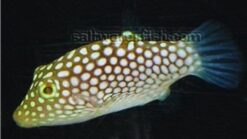
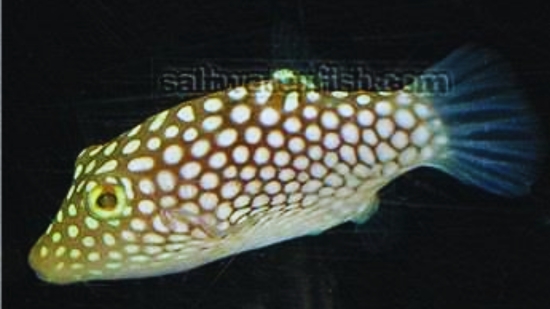
Hawaiian Spotted Puffer
Canthigaster jactator
| Stock | Variations | Price | Quantity |
|---|
Every order ships with our standard 3-hour live arrival guarantee. Need more time? Add our 5-Day Guarantee at checkout.
Full guarantee terms →Ships Monday – Thursday for next-day arrival at your nearest FedEx Hold location — typically ready by 9 AM. We monitor every delivery.
Shipping details →
Monday – Friday 8 AM – 9 PM
Saturday 12 PM – 4 PM
Sunday 12 PM – 9 PM
Healthy, stable animals from vetted suppliers — inspected before packing, shipped overnight. Decades of experience built this model so we can deliver premium livestock at 30%+ less than you'd pay elsewhere.
| Care Level | Moderate |
|---|---|
| Temperament | Semi-Aggressive |
| Reef Safe | With Caution |
| Functional Benefit | Ornamental Only |
| Diet Type | Omnivore |
| Mininum Tank Size | 30 gallons |
| Max Size | 4 inches |
| Temperature | 72–78°F |
| pH Range | 8.1–8.4 |
| Specific Gravity | 1.022–1.025 |
The Hawaiian Spotted Puffer (Canthigaster jactator), also called the Hawaiian whitespotted toby, is a compact sharpnose (toby) puffer from the Hawaiian Islands with a dark body covered in distinct white spotting. Adults top out around 9 cm (about 3.5″) in length, making it a good fit when you want “puffer” personality without needing a very large aquarium.
What You’ll Observe:
- Uses quick, precise turns to cruise around rockwork and coral branches while it investigates surfaces
- Hovers and “paddles” with its pectoral fins, often stopping to inspect small details in the aquascape
- Learns feeding routines fast and commonly comes forward when you approach the tank
- Spends much of the day exploring, then tucking into a preferred nook to rest
To succeed with this toby puffer, provide an established aquarium with plenty of live rock arranged into caves and short swim lanes so it can explore and pause comfortably. Offer a varied mix of meaty foods, and include hard-shelled items (like clam/mussel or shell-on shrimp pieces) regularly to support natural feeding behavior. In mixed reef setups, most keepers plan livestock around its curious hunting style by choosing sturdier invertebrate options.
Will it eat snails, hermits, or ornamental shrimp?
It may treat small mobile invertebrates as food, so many hobbyists either skip delicate cleanup crews or use larger, more robust options.
Do I need to feed hard foods for its beak?
Offering hard-shelled foods periodically is a common approach, since toby puffers have fused, beak-like teeth and naturally crunch prey.
How often should I feed it?
Most keepers do best with smaller portions spread across the day, rotating foods so the fish stays engaged and well-conditioned.
Why does it “surf” the glass or follow me?
This is often normal “interactive” behavior in puffers—many quickly learn that people nearby can mean feeding time.
Is puffing up normal?
Yes—puffing can happen if it feels startled; calm handling and a low-stress acclimation setup help keep behavior steady.
Our selection process means you get robust, well-adjusted specimens that settle in quickly.
Recently viewed products