Spotted Garden Eel
Heteroconger hassi
| Stock | Variations | Price | Quantity | |
|---|---|---|---|---|
| Out of Stock | 4 - 7" - Indo-Pacific | Original price was: $136.99.$71.99Current price is: $71.99. | Email me |
Every order ships with our standard 3-hour live arrival guarantee. Need more time? Add our 5-Day Guarantee at checkout.
Full guarantee terms →Ships Monday – Thursday for next-day arrival at your nearest FedEx Hold location — typically ready by 9 AM. We monitor every delivery.
Shipping details →
Monday – Friday 8 AM – 9 PM
Saturday 12 PM – 4 PM
Sunday 12 PM – 9 PM
Healthy, stable animals from vetted suppliers — inspected before packing, shipped overnight. Decades of experience built this model so we can deliver premium livestock at 30%+ less than you'd pay elsewhere.
| Care Level | Expert |
|---|---|
| Temperament | Peaceful |
| Reef Safe | With Caution |
| Functional Benefit | Ornamental Only |
| Diet Type | Planktivore |
| Mininum Tank Size | 40 gallons |
| Max Size | 18 inches |
| Temperature | 74–80°F |
| pH Range | 8.1–8.4 |
| Specific Gravity | 1.022–1.025 |
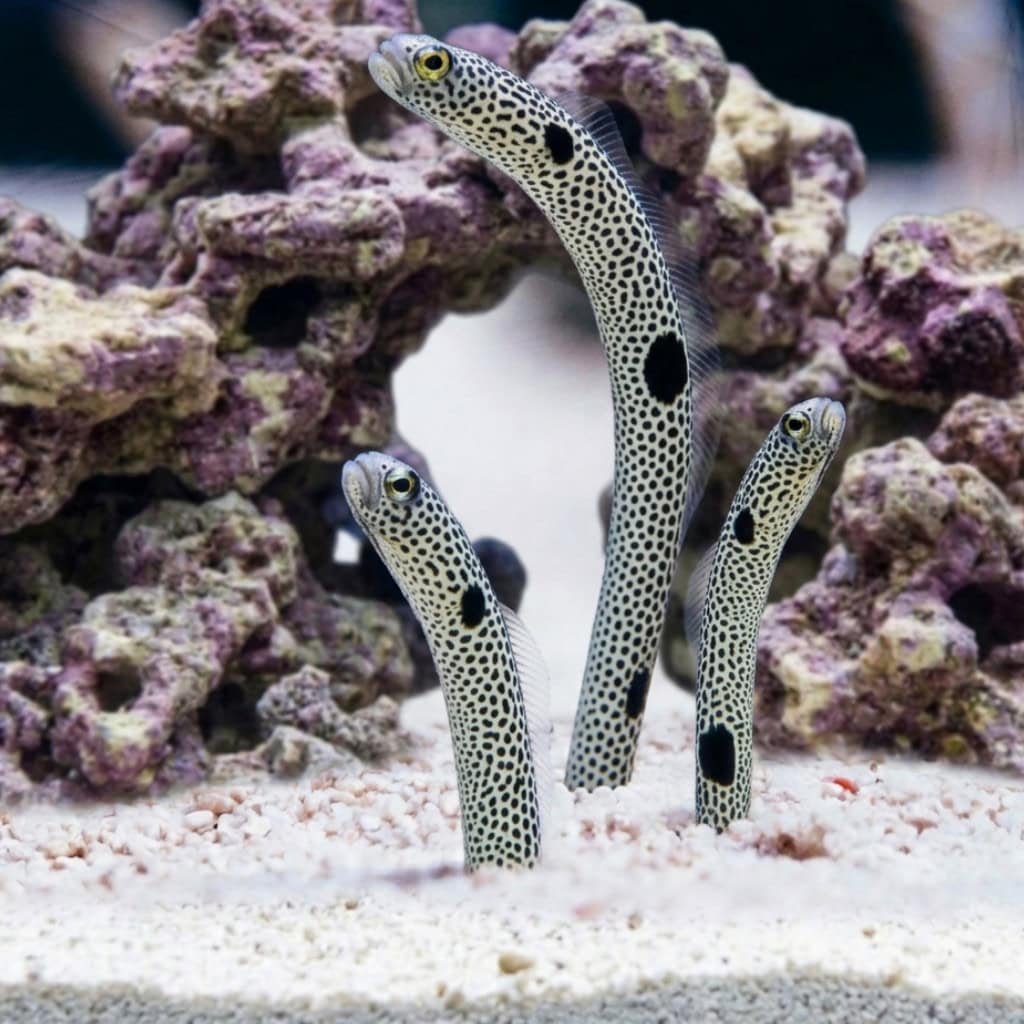
The Spotted Garden Eel (Heteroconger hassi) is a sand-dwelling eel that anchors into a burrow and extends its body into the water column to catch passing plankton. In a reef aquarium, it creates a “garden” effect as it sways in the current and retracts smoothly back into the sand between feedings.
What You’ll Observe:
- Establishes a home burrow and repeatedly returns to the same spot in the sand
- Spends long periods hovering upright, facing into the flow to intercept food
- Becomes most visible around regular feeding times and when the room is calm
- In a group, individuals space themselves out across open sand while sharing the same general area
Provide a wide, open sand zone with enough depth for secure burrowing, plus moderate-to-strong flow that keeps fine foods suspended. Offer small planktonic foods in multiple small feedings so it can grab bites from the water column. With consistent routine and an escape-proof top, it settles into a predictable daily pattern.
How deep does the sand really need to be for natural burrowing?
Most keepers build the system around the sand bed, using roughly 6″+ in the eel zone so the burrow stays stable and the eel can fully anchor.
Do they do better as a single eel or as a small group?
Hobbyists commonly keep them in small groups so they spread out and display more naturally, as long as there’s enough open sand for each eel to claim a spot.
What foods actually work best once they’re in the tank?
Keepers most often report success with very small, suspended foods (cyclops/cyclopeeze-style foods, roe/ova, baby brine), with some individuals also taking finely sized mysis once conditioned to the routine.
Why do they “disappear” for stretches of time after being added?
It’s normal for them to spend time adjusting their burrow and only extend out when conditions feel settled’consistent lighting, flow, and feeding timing usually brings them out more reliably.
How do you feed them in a mixed reef without everything else eating it first?
Many aquarists turn off or reduce return flow briefly and broadcast a cloud of fine foods upstream of the eel zone, repeating smaller portions so food passes the burrows multiple times.
Each fish is checked for strong appetite and activity before we approve it for your tank.
Recently viewed products